
NIST CSF 2.0 Detect – Adverse Event Analysis (DE.AE) Explained
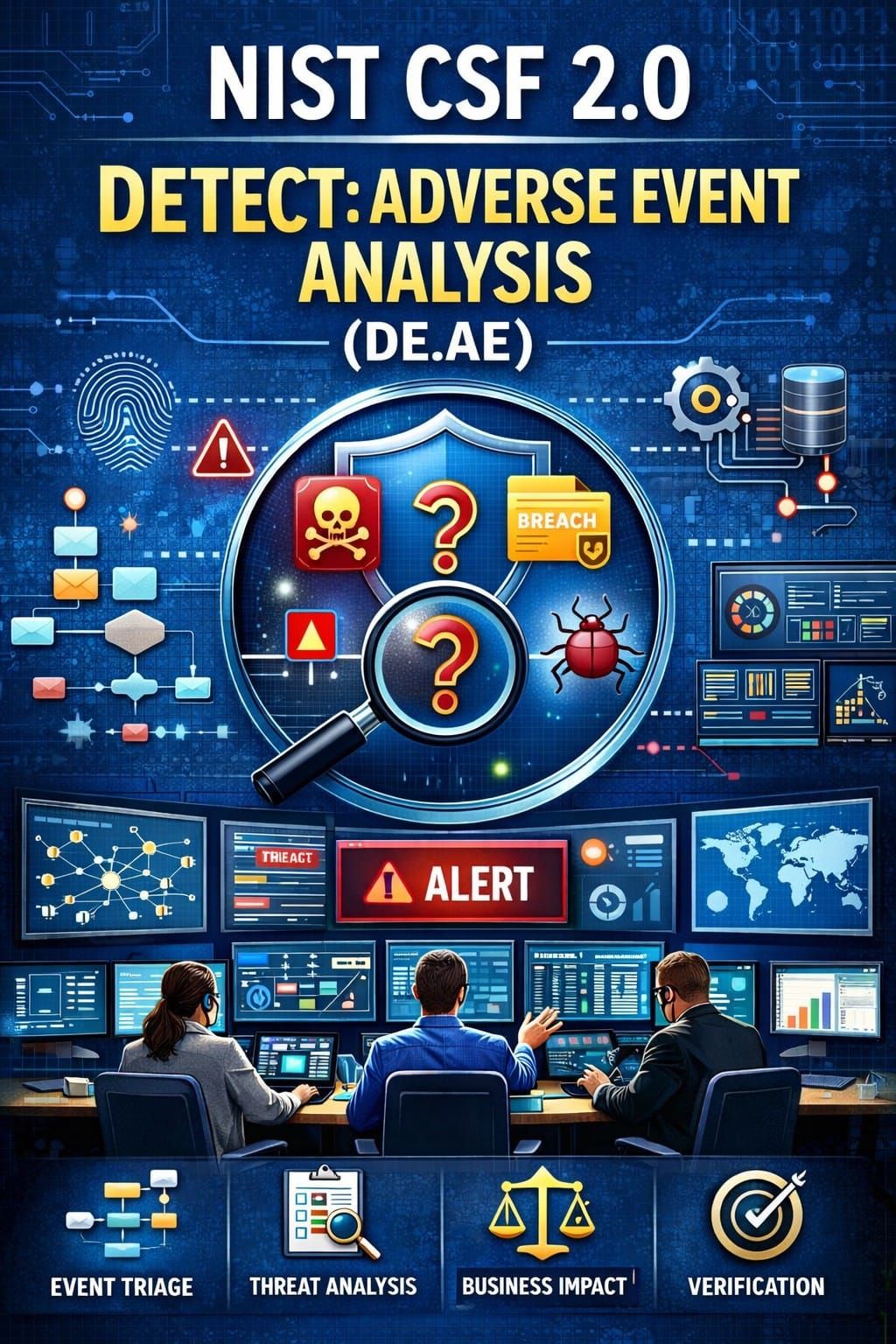
Detecting an event is only half the battle. What separates an effective security organization from a noisy one is the ability to analyze what was detected and determine whether it actually matters.
That is the role of NIST CSF 2.0 Detect – Adverse Event Analysis (DE.AE).
If DE.CM is about seeing activity, DE.AE is about understanding it. For aspiring CISOs and early-career security professionals, DE.AE is where analytical rigor, judgment, and business context come together.
What Is DE.AE in NIST CSF 2.0?
DE.AE focuses on the organization’s ability to analyze detected events to understand their scope, impact, and significance.
In practical terms, DE.AE answers:
“Now that we’ve detected something, what does it actually mean?”
Under CSF 2.0, Adverse Event Analysis includes:
- Confirming whether an event is malicious or benign
- Determining affected assets, users, and data
- Assessing business and operational impact
- Establishing confidence levels for response decisions
Without DE.AE, organizations drown in alerts—or worse, miss real incidents hiding in plain sight.
Why DE.AE Matters at the Leadership Level
As a CISO, one of the fastest ways to lose credibility with executives is to escalate events without clarity.
DE.AE directly impacts:
- Decision quality during incidents
- Speed and accuracy of response
- Containment effectiveness
- Executive trust in the security function
Strong analysis prevents overreaction and underreaction—both of which carry risk.
Core Objectives of DE.AE
A mature DE.AE capability ensures that:
- Detected events are consistently analyzed
- Analysts can differentiate signal from noise
- Impact is assessed in business terms
- Response actions are proportional and justified
This is where security becomes risk management—not just tool operation.
How to Implement DE.AE Effectively
1. Establish Clear Event Triage Criteria
Not every alert deserves the same treatment.
Define:
- Severity levels
- Confidence thresholds
- Asset criticality tiers
- Escalation triggers
This prevents analysis paralysis and inconsistent handling.
2. Standardize Analysis Playbooks
Effective DE.AE relies on repeatable analytical processes.
Playbooks should guide analysts through:
- Initial validation steps
- Required evidence collection
- Lateral movement checks
- Data exposure verification
- Impact assessment questions
Consistency is more important than perfection.
3. Incorporate Threat Intelligence and Context
Analysis without context leads to false conclusions.
Incorporate:
- Threat actor TTPs
- MITRE ATT&CK mapping
- Known campaign indicators
- Environmental baselines
This helps analysts understand intent, not just activity.
4. Integrate Business Impact Early
Aspiring CISOs often overlook this step.
DE.AE should quickly answer:
- What systems are involved?
- What data is at risk?
- What business processes are affected?
- Is there regulatory exposure?
This enables informed executive decisions—fast.
5. Close the Loop With Detection and Response
DE.AE outcomes should improve:
- Detection tuning
- Incident response playbooks
- Risk assessments
- Control investments
Analysis that doesn’t feed improvement is wasted effort.
Metrics to Measure DE.AE Effectiveness
Operational Metrics
- Mean Time to Analyze (MTTA)
- % of events escalated correctly
- Analyst rework rates
- Evidence completeness rates
Effectiveness Metrics
- False positive reduction over time
- Incidents downgraded after analysis
- Missed incidents identified via post-review
- Accuracy of initial severity assignments
Program Maturity Metrics
- % of events analyzed using playbooks
- % mapped to threat frameworks
- Analyst confidence scoring consistency
- Executive satisfaction with incident briefings
Metrics should reinforce clarity and confidence, not speed alone.
Common DE.AE Pitfalls
From experience, these derail many programs:
- Treating analysis as optional
- Relying solely on automated verdicts
- Ignoring asset and data classification
- Over-escalation “just in case”
- Under-documenting analysis decisions
Good analysis leaves a clear audit trail of why decisions were made.
Final Advice for Aspiring CISOs
If DE.CM tells you something happened, DE.AE tells you whether leadership needs to care.
Strong Adverse Event Analysis:
- Builds confidence during crises
- Improves response effectiveness
- Protects credibility with executives
- Creates institutional learning over time
This is where security professionals evolve into security leaders.
Comments ()