
NIST CSF 2.0 – GOVERN (GV.OV): Turning Governance Into Oversight That Works
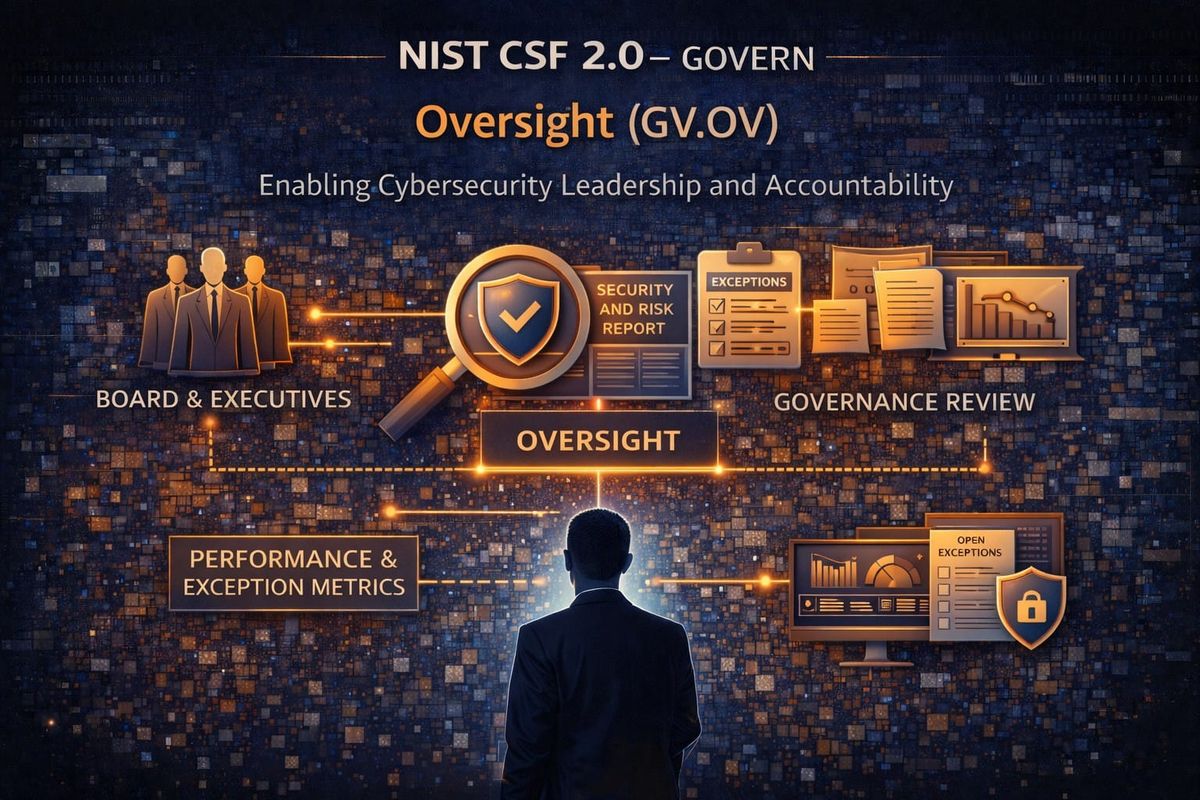
In the previous post on GV.PO – Policies, Processes, and Procedures, we focused on how organizations define expectations for cybersecurity. But governance does not stop at documentation. Policies without oversight are aspirational at best—and risky at worst.
This is where GV.OV (Oversight) comes in.
Under NIST CSF 2.0, GV.OV ensures that cybersecurity governance is actively monitored, challenged, and reinforced by leadership. It transforms governance from a static control set into a living management discipline.
What GV.OV Really Means in Practice
GV.OV focuses on accountability. It ensures that:
- Cybersecurity decisions are made at the right level
- Risk is understood, accepted, or rejected explicitly
- Leadership visibility extends beyond dashboards and heat maps
In short: someone is clearly responsible, and oversight mechanisms exist to confirm cybersecurity is being executed as intended.
This category ties cybersecurity directly to enterprise governance, not just IT operations.
Core Objectives of GV.OV
GV.OV is concerned with answering four critical questions:
- Who provides oversight of cybersecurity risk?
- How is cybersecurity performance reviewed?
- How are exceptions and risk decisions governed?
- How does leadership stay informed—and involved?
Without clear answers, organizations often experience:
- “Security theater” reporting
- Informal risk acceptance
- Leadership surprise during incidents
Key Oversight Mechanisms You Should Have
Effective GV.OV implementation typically includes:
1. Defined Cybersecurity Oversight Roles
Oversight must be explicitly assigned, such as:
- Board committees
- Executive leadership (CIO, CISO, CRO)
- Risk or audit committees
Oversight is not the same as execution—the people monitoring cybersecurity should not be the same ones building the controls.
2. Formal Risk Acceptance and Exception Processes
When controls cannot be implemented:
- Risk acceptance should be documented
- Time-bound exceptions should be approved
- Residual risk must be visible to leadership
GV.OV ensures risk decisions are intentional, traceable, and owned.
3. Regular Governance and Risk Reviews
Oversight requires cadence:
- Cyber risk reviews
- Control effectiveness assessments
- Third-party risk summaries
- Incident trend analysis
These reviews should drive decisions, not just produce slides.
4. Performance and Accountability Metrics
GV.OV is not purely qualitative. Mature organizations track:
- Policy compliance rates
- Open risk exceptions
- Audit findings
- Control coverage gaps
- Incident and near-miss trends
These metrics tie directly back to GV.PO artifacts—closing the governance loop.
How GV.OV Complements GV.PO
Think of GV.PO and GV.OV as two halves of the same control system:
| Category | Purpose |
|---|---|
| GV.PO | Defines what should happen |
| GV.OV | Confirms what is actually happening |
Without GV.OV:
- Policies drift out of alignment
- Exceptions quietly become permanent
- Leadership loses trust in security reporting
Common GV.OV Pitfalls to Avoid
Many organizations struggle with oversight due to:
- Treating cybersecurity as a technical issue instead of a governance issue
- Relying solely on annual audits for oversight
- Allowing informal risk acceptance
- Overloading executives with metrics that lack decision context
GV.OV succeeds when oversight is clear, structured, and action-oriented.
Why GV.OV Matters to CISOs and Future Leaders
For CISOs, GV.OV provides:
- Authority backed by governance
- Transparency into leadership decisions
- Protection from implicit risk ownership
For aspiring InfoSec professionals, understanding GV.OV is critical to moving from technical contributor to security leader. Governance literacy is often what separates senior practitioners from executives.
Final Thoughts: Governance Is Not Complete Without Oversight
NIST CSF 2.0 intentionally elevated GOVERN to a first-class function. GV.OV is a core reason why.
Policies set direction.
Oversight ensures accountability.
Together, GV.PO and GV.OV turn cybersecurity from theory into managed risk.
In the next posts, the focus will shift from governance into how those decisions drive Identify, Protect, Detect, Respond, and Recover—where oversight makes the difference between preparation and regret.
Comments ()