
NIST CSF 2.0 – GOVERN (GV.SC): Governing Cyber Risk Beyond Your Organizational Boundaries
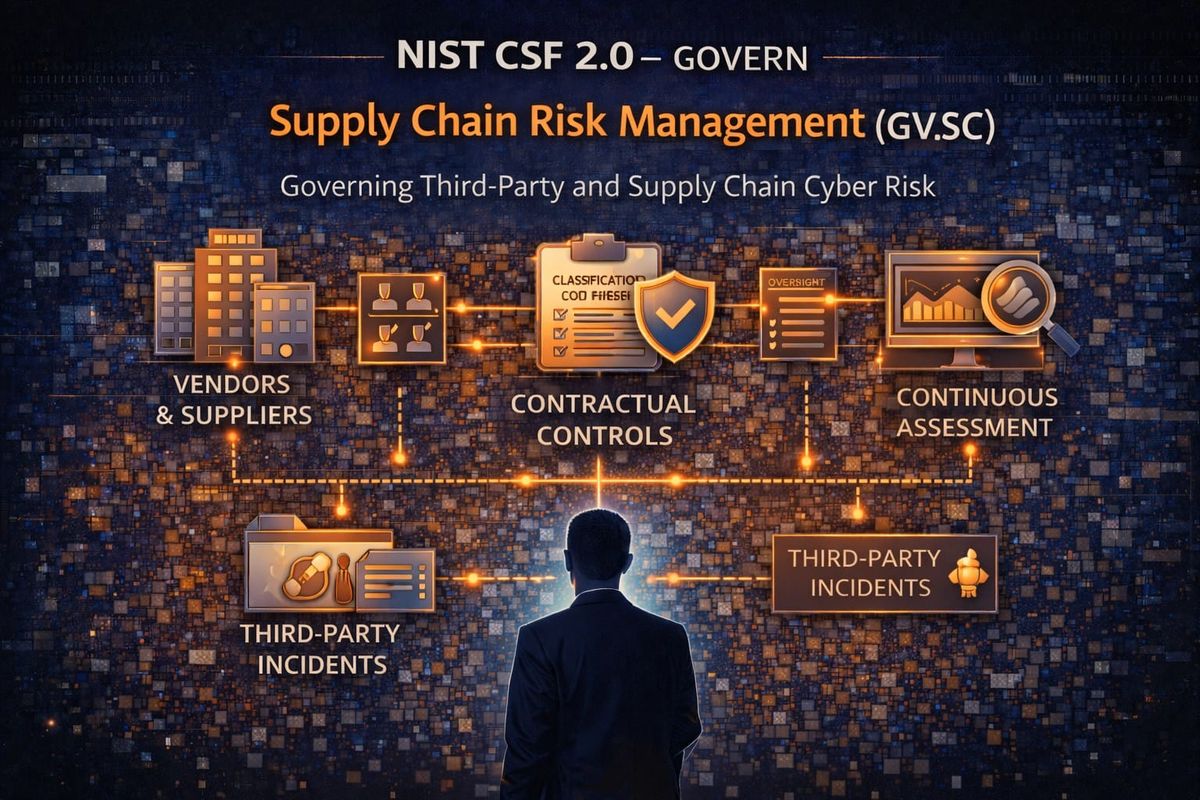
Cybersecurity governance does not stop at your network perimeter.
Modern enterprises rely on a complex ecosystem of vendors, cloud providers, SaaS platforms, integrators, and partners. Each dependency introduces risk—often outside the direct control of the CISO. GV.SC (Supply Chain Risk Management) exists to ensure those risks are governed with the same rigor as internal cybersecurity controls.
In NIST CSF 2.0, GV.SC formalizes how organizations identify, assess, manage, and oversee cybersecurity risk originating from suppliers and third parties.
What GV.SC Is Designed to Address
GV.SC focuses on governing risks that arise from:
- Third-party service providers
- Software supply chains and dependencies
- Cloud and managed service providers
- Strategic business partners
- Mergers, acquisitions, and outsourcing
While technical controls may reduce exposure, governance ensures that supply chain risk is understood, accepted, mitigated, or avoided at the leadership level.
Why Supply Chain Risk Is a Governance Issue
Many organizations treat third-party risk as:
- A compliance exercise
- A procurement checklist
- A one-time questionnaire
GV.SC elevates this into a strategic governance function, ensuring that:
- Leadership understands concentration and dependency risk
- Cyber risk informs sourcing and contracting decisions
- Suppliers are held accountable throughout the relationship lifecycle
From SolarWinds to Log4j to SaaS breaches, history has shown that unmanaged supplier risk quickly becomes enterprise risk.
Core Components of GV.SC Implementation
1. Defined Supply Chain Risk Ownership
Supply chain risk governance requires clarity on:
- Who owns third-party cyber risk?
- Who accepts residual vendor risk?
- How escalation occurs when supplier risk exceeds tolerance?
In mature programs, this responsibility is shared across security, procurement, legal, and executive leadership.
2. Risk-Based Supplier Classification
Not all suppliers carry the same risk.
Organizations should categorize suppliers based on:
- Access to sensitive data
- Network connectivity
- Operational criticality
- Regulatory impact
This enables proportional governance, where oversight intensity matches risk exposure.
3. Security Requirements Embedded in Contracts
GV.SC expects organizations to govern supplier security through:
- Contractual security requirements
- Right-to-audit clauses
- Incident notification timelines
- Data protection expectations
Governance means these requirements are not optional—they are enforced.
4. Continuous Oversight and Reassessment
Supplier risk is not static.
GV.SC encourages:
- Periodic reassessment of critical suppliers
- Monitoring for changes in ownership or services
- Integration of threat intelligence affecting vendors
- Oversight of fourth-party risk when applicable
This directly ties GV.SC into GV.OV (Oversight) mechanisms.
Metrics That Matter for GV.SC
Effective governance demands measurable insight. Common GV.SC metrics include:
- Percentage of critical suppliers with current risk assessments
- Number of high-risk suppliers with approved remediation plans
- Time to remediate identified supplier risks
- Open supplier risk exceptions
- Incidents originating from third parties
These metrics should be reviewed at the same governance forums as enterprise cyber risk.
Common GV.SC Pitfalls
Organizations often struggle with GV.SC due to:
- Overreliance on questionnaires
- Lack of enforcement authority
- Inconsistent supplier evaluations
- Poor visibility into subcontractors
- No executive ownership of residual risk
GV.SC succeeds when supply chain security is treated as a shared governance responsibility, not just a security control.
Why GV.SC Completes the GOVERN Function
With GV.SC, the Govern function becomes comprehensive:
- GV.OC defines context
- GV.RM sets risk strategy
- GV.RR assigns roles
- GV.PO establishes rules
- GV.OV enforces oversight
- GV.SC extends governance beyond the organization
Together, these categories ensure cybersecurity governance is holistic, intentional, and resilient to modern operational realities.
Final Thoughts: You Are Only as Secure as Your Dependencies
For CISOs and security leaders, GV.SC represents a shift in mindset:
Cybersecurity is no longer just about what you control—it’s about what you rely on.
Organizations that govern supply chain risk proactively:
- Reduce systemic exposure
- Enable faster incident response
- Make better sourcing decisions
- Build executive trust in security leadership
Completing the GOVERN function is not about paperwork—it’s about owning cyber risk wherever it exists.
Comments ()