
NIST CSF 2.0 – Identify Function Deep Dive: Improvement (ID.IM)
Most cybersecurity programs don’t fail because they lack controls.
They fail because they fail to learn.
Incidents happen. Audits surface gaps. Assessments reveal weaknesses.
Yet many organizations treat these moments as interruptions instead of inputs.
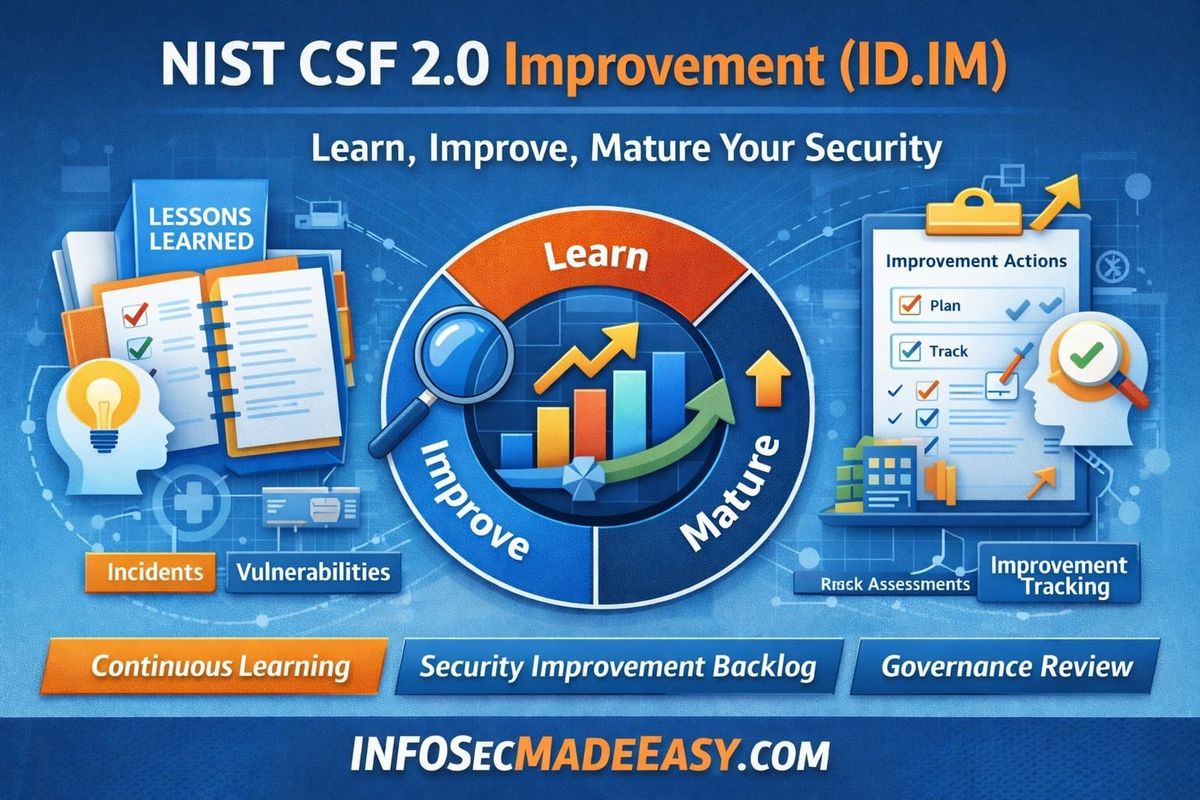
That is exactly why Improvement (ID.IM) exists in the NIST Cybersecurity Framework (CSF) 2.0 Identify function. ID.IM ensures the organization systematically learns from experience and uses that learning to strengthen governance, risk management, and strategic execution.
In CSF 2.0, improvement is no longer implied—it is explicit, measurable, and expected.
This post covers:
- What ID.IM is in NIST CSF 2.0
- How mature organizations operationalize continuous improvement
- Metrics that demonstrate learning, not just activity
What Is NIST CSF 2.0 Improvement (ID.IM)?
ID.IM focuses on identifying opportunities for improvement in cybersecurity governance, risk management, and controls based on:
- Incidents and near misses
- Risk assessments
- Audits and assessments
- Exercises and testing
- Threat intelligence and environmental changes
The key shift in CSF 2.0 is that improvement is positioned as a governance responsibility, not a SOC or GRC afterthought.
If lessons are learned but not acted on, improvement does not exist.
Why Cybersecurity Improvement Commonly Stalls
Across enterprises of every maturity level, the same friction points appear:
- Lessons learned, lessons forgotten
Reports are written but never tracked to completion. - No ownership
Findings exist, but accountability does not. - Competing priorities
Improvement work loses to urgent operational demands. - No measurement
Organizations cannot demonstrate that they are getting better—only busier. - Fear of visibility
Teams avoid surfacing weaknesses to prevent scrutiny.
CSF 2.0 ID.IM directly counters these behaviors by requiring intentional learning cycles.
How to Implement ID.IM in a Practical, Scalable Way
1. Treat Every Major Event as an Improvement Input
Improvement inputs should include:
- Security incidents and near misses
- Tabletop and simulation exercises
- Penetration tests and red team activities
- Internal audits and external assessments
- Material risk register changes
The goal is not perfection—it is pattern recognition.
2. Formalize a Cybersecurity Improvement Backlog
Mature organizations maintain a visible, prioritized improvement backlog that:
- Tracks findings across all sources
- Assigns clear owners and deadlines
- Maps each improvement to a CSF category or control area
- Aligns improvements to risk reduction
This turns learning into managed execution, not good intentions.
3. Link Improvements to Risk and Business Outcomes
Improvements should clearly answer:
- Which risk does this reduce?
- Which business outcome does this protect?
- What happens if it is delayed?
This framing ensures improvement work competes fairly for funding and attention.
4. Ensure Improvement Is Governed, Not Just Executed
Strong ID.IM programs include:
- Regular review of improvement status at governance forums
- Executive visibility into overdue or blocked actions
- Clear escalation paths when improvement stalls
Improvement without oversight is optional.
Improvement with governance is inevitable.
5. Feed Improvements Back Into Strategy and Architecture
ID.IM is not only tactical.
Mature organizations:
- Adjust security roadmaps based on recurring themes
- Refine risk appetite statements
- Update policies and standards
- Evolve architecture patterns
This is where improvement compounds over time.
Metrics That Show Real Improvement
ID.IM metrics must demonstrate learning velocity and execution discipline.
Foundational Metrics
- % of incidents with completed post-incident reviews
- % of exercises resulting in documented improvement actions
- Time to log improvement items after discovery
- Improvement backlog size by category
These show process existence.
Execution & Accountability Metrics
- % of improvement actions completed on time
- Average age of open improvement items
- % of overdue improvement actions escalated
- Improvement actions with assigned executive owners
These show management seriousness.
Outcome & Maturity Metrics
- Reduction in repeat findings year over year
- Reduction in repeat incident root causes
- Control effectiveness improvement trends
- Risk reduction tied to completed improvements
These prove the organization is actually getting better.
What Good Looks Like
A CSF 2.0-aligned ID.IM capability means:
- The organization learns from incidents instead of repeating them
- Weaknesses are surfaced early, not hidden
- Improvement work is visible and tracked
- Strategy evolves based on evidence, not assumptions
- Security maturity increases year over year
In these environments, improvement becomes cultural—not forced.
Final Thoughts from the CISO Chair
Cybersecurity is a contact sport.
You only improve by engaging, observing, and adjusting.
NIST CSF 2.0 makes improvement explicit because resilience depends on it.
Controls may stop yesterday’s attack.
Learning stops tomorrow’s failure.
If your program does not systematically improve, it is quietly decaying—no matter how many tools are deployed.

Comments ()