
NIST CSF 2.0 Policies, Processes, and Procedures (GV.PO): Turning Governance Into Operational Reality
After decades leading cybersecurity programs in large, global organizations, I’ve learned that governance only matters when it shows up in daily decisions. Policies that live in binders, processes that no one follows, and procedures that exist only for audits do not reduce risk—they create the illusion of control.
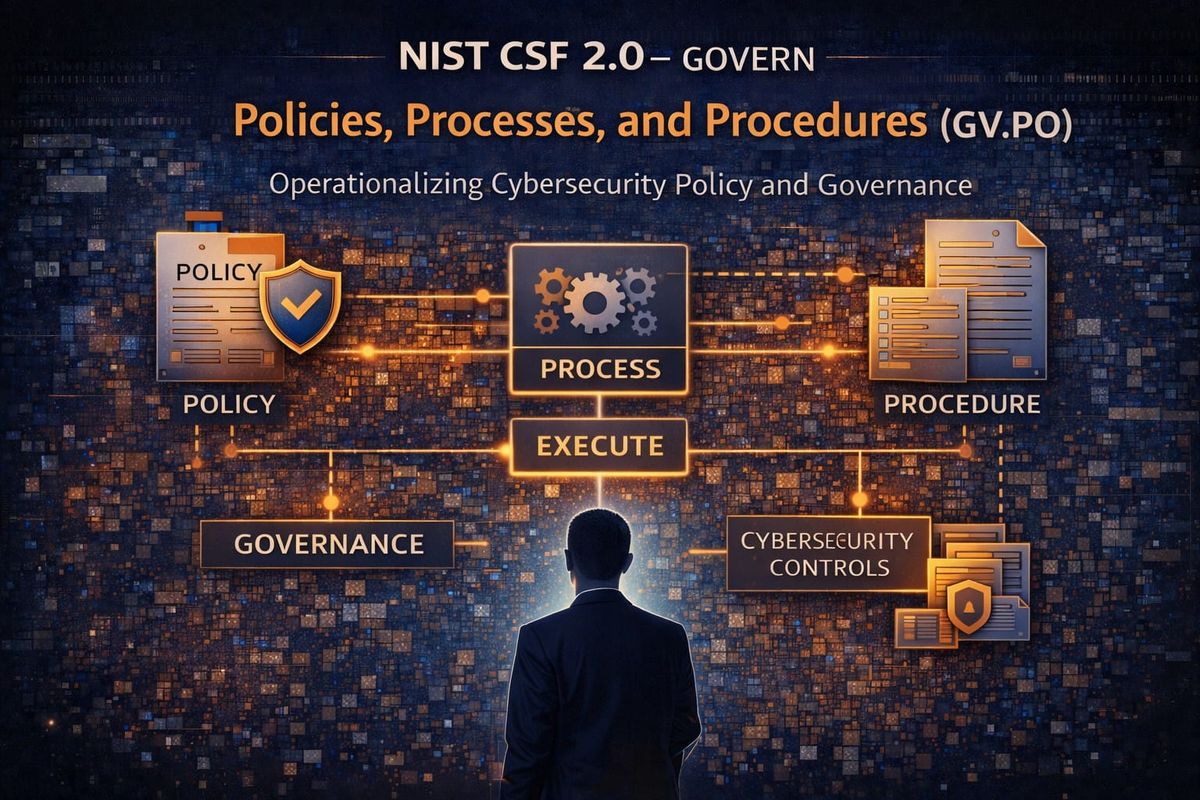
The GV.PO category in NIST CSF 2.0 exists to close that gap. Where Organizational Context defines what matters, Risk Management Strategy defines how decisions are made, and Roles and Responsibilities define who decides, GV.PO defines how governance is operationalized across the enterprise.
What GV.PO Is
GV.PO – Policies, Processes, and Procedures ensures that cybersecurity governance is formalized, actionable, and consistently executed across the organization.
GV.PO addresses questions leaders often overlook:
- Do our policies reflect how we actually operate?
- Are processes designed for the business or for auditors?
- Can teams execute security procedures under pressure?
- Are governance decisions translated into repeatable actions?
- Do our controls scale as the organization changes?
In short, GV.PO is where governance becomes real—or irrelevant.
Why GV.PO Matters to CISOs and Executives
From an executive perspective, GV.PO creates consistency, resilience, and defensibility.
When done well:
- Security decisions are predictable and repeatable
- Teams know what “good” looks like without interpretation
- Regulatory and audit confidence improves
- Operational risk decreases—even during disruption
When GV.PO is weak:
- Policies are ignored or bypassed
- Processes slow the business
- Incidents expose procedural gaps
- Leaders discover governance failures too late
Effective cybersecurity leadership requires more than intent—it requires execution.
How to Implement GV.PO in Practice
1. Design Policy With Purpose
Security policies should be:
- Principle-based, not control catalogs
- Clear enough for non-security leaders to understand
- Directly tied to business and risk objectives
Strong policies set direction—they do not attempt to document every scenario.
2. Align Processes to How the Business Operates
Processes are where security either helps or hinders execution.
Effective GV.PO processes:
- Support business workflows instead of interrupting them
- Clearly define inputs, outputs, and owners
- Minimize friction while preserving risk controls
Processes that exist only for compliance will be bypassed when pressure mounts.
3. Make Procedures Executable Under Stress
Procedures must work during:
- Incidents
- System outages
- Leadership unavailability
- Time pressure
This means:
- Clear, step-by-step guidance
- Defined decision points and escalation paths
- Regular testing through exercises and simulations
If procedures cannot be executed at 2 a.m. during a crisis, they will fail when it matters most.
4. Ensure Traceability Between Governance and Operations
GV.PO requires clear linkage:
- Policies → Processes → Procedures → Controls
- Governance decisions → operational actions
- Risk acceptance → compensating procedures
Traceability prevents drift between intent and reality.
5. Review, Test, and Adapt Continuously
Governance artifacts must evolve with the business.
Leading organizations:
- Review policies on a defined cadence
- Update processes following incidents or major changes
- Retire procedures that no longer reflect reality
- Incorporate lessons learned into governance
Static governance is silent risk accumulation.
Metrics That Matter for GV.PO
Measuring GV.PO is about effectiveness and adoption, not document volume.
Policy Effectiveness Metrics
- Percentage of policies reviewed on schedule
- Leadership understanding of policy intent
- Reduction in policy-related exceptions
Process Performance Metrics
- Time to complete key security processes
- Process adherence rates
- Business satisfaction with security workflows
Procedure Readiness Metrics
- Success rate of incident exercises
- Number of procedural failures during incidents
- Mean time to execute critical procedures
Governance-to-Operations Indicators
- Reduced audit findings tied to execution gaps
- Improved control consistency across environments
- Faster response during disruptions
These metrics show whether governance actually works.
Common GV.PO Failure Patterns
Across organizations, the same mistakes repeat:
- Overly prescriptive policies
- Processes designed without business input
- Unused or outdated procedures
- Governance driven solely by compliance timelines
- Lack of ownership for maintenance
GV.PO exists to break these patterns.
How GV.PO Completes the Govern Controls
Together, the Govern categories form a complete governance system:
- GV.OC – Defines what matters
- GV.RM – Defines how risk is managed
- GV.RR – Defines who decides and acts
- GV.PO – Defines how governance is executed
This is the minimum foundation for sustainable cybersecurity leadership.
Final Thought
In NIST CSF 2.0, GV.PO is the difference between governance that exists on paper and governance that survives reality. For CISOs, policies, processes, and procedures are not administrative overhead—they are the mechanisms through which intent becomes action.
Strong cybersecurity programs are built on controls.
Durable cybersecurity governance is built on execution.

Comments ()