
NIST CSF 2.0 – Protect Function Deep Dive: Data Security (PR.DS)
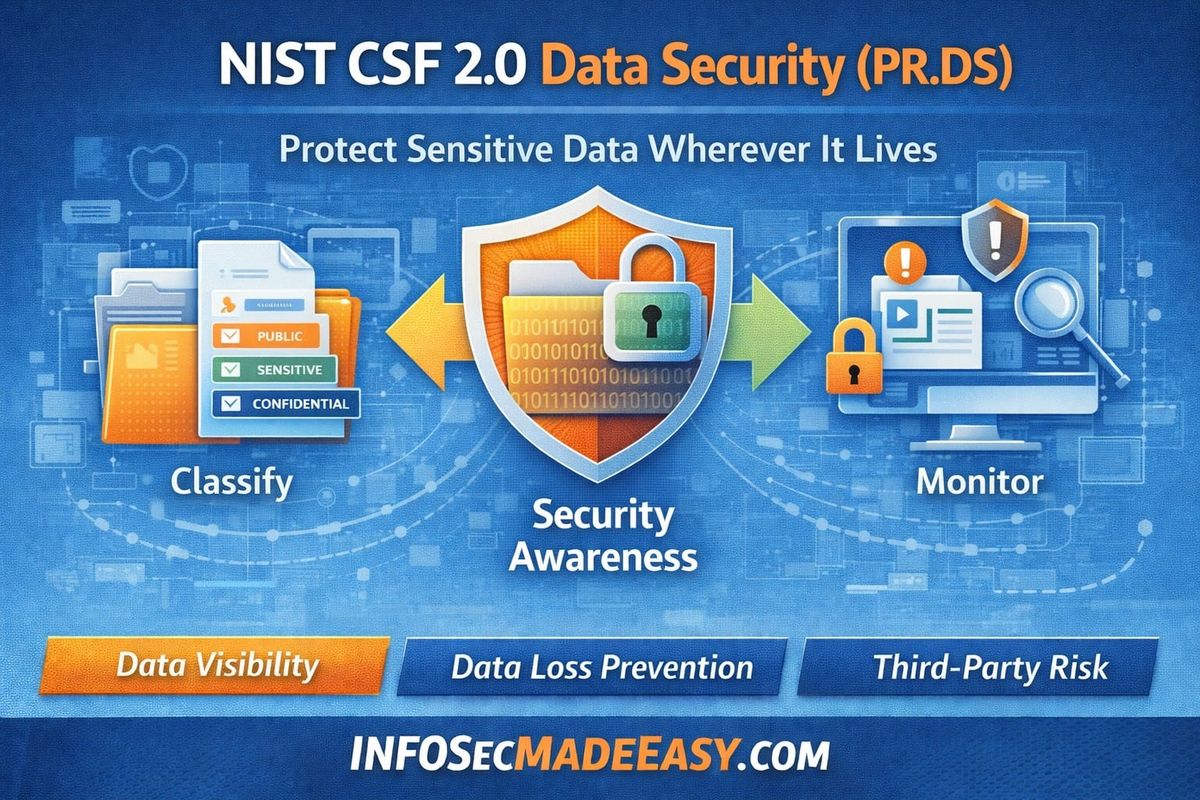
When executives ask, “What are we actually protecting?”
The honest answer is simple:
Data.
Not servers.
Not applications.
Not networks.
Those matter—but only because data lives on them.
PR.DS exists because cybersecurity failures become business crises only when data is exposed, altered, lost, or misused. Everything else is usually recoverable.
How PR.DS Fits Into the Protect Function
So far in the Protect series, we have covered:
- PR.AA – Who can access systems and data
- PR.AT – How people recognize and respond to risk
PR.DS answers the next, unavoidable question:
Once access is granted and people are trained—how is data actually protected?
This is where cybersecurity aligns directly with:
- Regulatory exposure
- Financial loss
- Reputation damage
- Customer trust
For new practitioners, PR.DS explains what data security really means.
For new CISOs, it defines where accountability truly begins.
What Is PR.DS (Plain English)
PR.DS ensures that data is protected throughout its entire lifecycle.
That lifecycle includes:
- Creation
- Storage
- Use
- Transmission
- Retention
- Disposal
PR.DS applies whether data is:
- On-prem
- In the cloud
- In SaaS platforms
- On laptops
- In backups
- Shared with third parties
If data exists somewhere, PR.DS applies.
Beginner Callout: Why Data Security Is Harder Than It Sounds
Many people assume data security means:
- Encryption
- Passwords
- Firewalls
Those are tools, not strategies.
Data security is difficult because:
- Data constantly moves
- Copies multiply invisibly
- Business users prioritize speed
- Ownership is often unclear
You can’t protect what you don’t understand—or can’t see.
Why PR.DS Matters So Much at the Executive Level
From the boardroom perspective:
- Most fines are data-related
- Most lawsuits follow data exposure
- Most breach notifications mention data types
- Most incident impact assessments start with data loss
Executives don’t ask:
“Was the server patched?”
They ask:
“What data was exposed, and who was affected?”
PR.DS is how security leaders answer that question confidently.
Common PR.DS Mistakes (Across All Maturity Levels)
1. Trying to Protect All Data Equally
Not all data deserves the same level of protection.
Customer PII ≠ marketing content
Production credentials ≠ internal documentation
Without prioritization, controls become expensive and ineffective.
2. Confusing Storage Security With Data Security
Securing a database does not mean the data is secure if:
- It’s exported to spreadsheets
- Shared through email
- Synced to personal devices
- Uploaded to unauthorized SaaS tools
Data security follows data—not infrastructure.
3. Leaving Classification as a Paper Exercise
If data classification:
- Is purely theoretical
- Isn’t enforced technically
- Isn’t understood by users
Then it provides little real protection.
How to Implement PR.DS in a Practical, Understandable Way
1. Start With Data Visibility
At a minimum, organizations should understand:
- What sensitive data they have
- Where it lives
- Who accesses it
- How it moves
You do not need perfection—but you need directional clarity.
2. Classify Data Based on Impact, Not Preference
Effective classification answers:
- What happens if this data is exposed?
- What happens if it’s altered?
- What happens if it’s unavailable?
Focus on impact—not volume.
This keeps programs realistic and defensible.
3. Protect Data in Use, Not Just at Rest
Encryption at rest and in transit are table stakes.
Mature PR.DS programs also address:
- Screenshots
- Copy/paste
- File sharing
- Downloads
- External uploads
This is where DLP, CASB, and modern cloud controls matter most.
4. Limit Data Retention Aggressively
Data you no longer need:
- Still creates risk
- Still expands breach scope
- Still costs money to secure
Deleting data safely is one of the most underrated security controls.
5. Account for Third Parties Explicitly
Once data leaves your environment:
- Your risk does not leave with it
- Your accountability often remains
PR.DS requires:
- Contractual protections
- Minimum security requirements
- Visibility into data sharing
Real-World Executive Example
A company experiences a cloud credential compromise.
The attack path is simple.
The impact, however, depends entirely on PR.DS:
- If sensitive data is segmented, encrypted, and monitored → limited impact
- If data is broadly accessible and poorly classified → board-level crisis
Same incident.
Very different outcome.
That difference is PR.DS maturity.
Metrics That Make PR.DS Understandable
Foundational Metrics
- % of critical data classified
- % of sensitive data encrypted
- % of endpoints enforcing data protection controls
- Number of external data-sharing paths
These show coverage.
Risk-Oriented Metrics
- Data exposure incidents by type
- Sensitive data access anomalies
- Unauthorized data sharing attempts
- Data retention exceptions
These show risk control effectiveness.
CISO Takeaways
For new CISOs especially:
- Data is what regulators care about
- Data is what customers care about
- Data is what lawsuits reference
- Data is what defines breach severity
If you control data well, many other failures become survivable.
If you don’t, even small incidents become existential.
What “Good” Looks Like
A strong PR.DS capability means:
- Sensitive data is known and prioritized
- Protection follows data wherever it goes
- Users understand how to handle data safely
- Retention is intentional, not accidental
- Leadership can speak clearly about data risk
For beginners, this provides clarity.
For CISOs, it provides defensibility.
Final Thoughts
Identity controls decide who gets in.
Awareness determines how people behave.
Data security defines what actually gets damaged.
PR.DS is where cybersecurity and business risk finally meet.
If you protect data well,
you earn time, trust, and options when things go wrong.


Comments ()