
NIST CSF 2.0 – Protect Function Deep Dive: Technology Infrastructure Resilience (PR.IR)
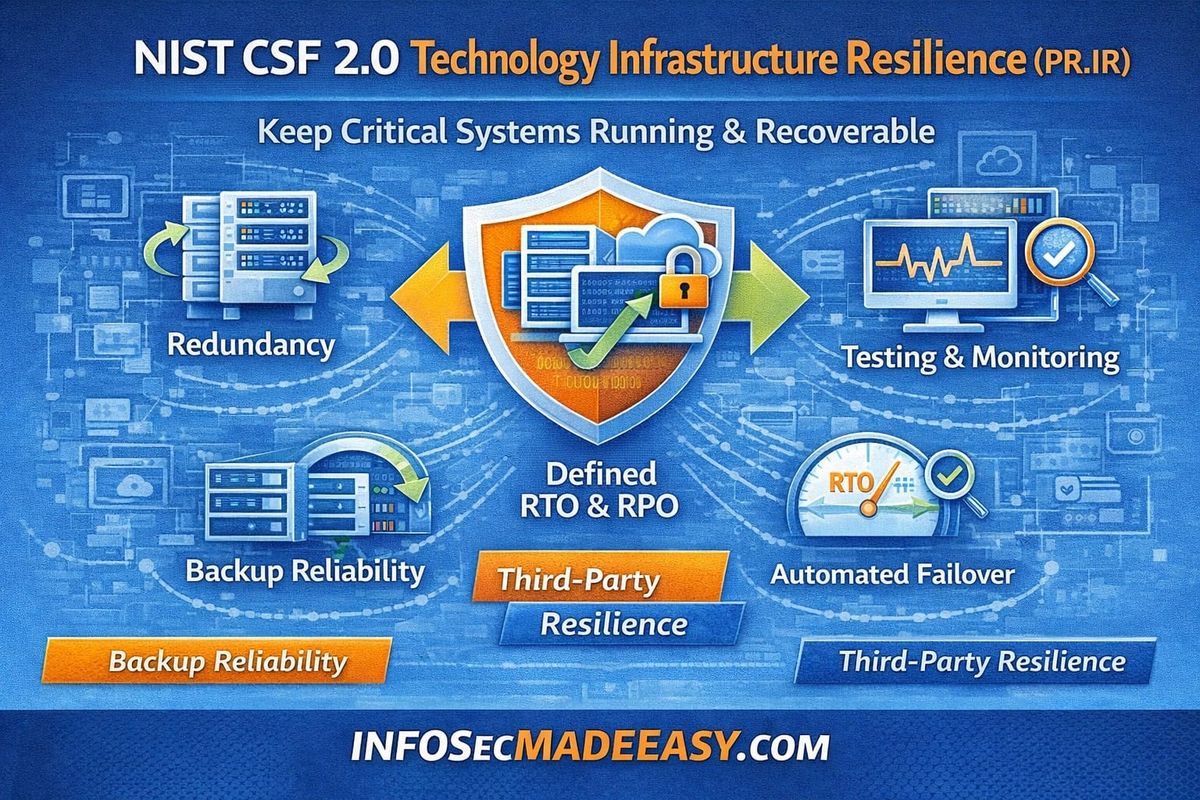
Modern enterprises depend on technology everywhere. From cloud workloads to on-prem servers, from network devices to IoT sensors, businesses operate on the assumption that infrastructure “just works.”
But what happens when it doesn’t?
- Critical applications go offline
- Customers can’t access services
- Production lines grind to a halt
- Data is temporarily unavailable or corrupted
PR.IR – Technology Infrastructure Resilience – exists because availability, redundancy, and recoverability are as important as confidentiality and integrity. If systems fail and cannot recover, even perfectly configured identity and data controls won’t save the organization.
How PR.IR Fits Into the Protect Function
So far in Protect, we’ve focused on:
- PR.AA – Identity and access
- PR.AT – Human awareness and training
- PR.DS – Data protection
- PR.PS – Platform security
PR.IR addresses the next question:
“Even with strong access, trained people, protected data, and secure platforms, how do we ensure technology continues to operate under adverse conditions?”
PR.IR is about resilience—making sure systems stay running, can recover quickly, and continue to support business operations when faced with disruption.
Beginner Callout: What “Technology Infrastructure Resilience” Really Means
Resilience is not just backups or high availability. It includes:
- Redundant systems that can take over automatically
- Rapid recovery plans for downtime or disaster
- Scalability under load to prevent outages
- Monitoring and detection that anticipate failure
- Contingency planning for third-party and cloud dependencies
Think of it like a bridge: it’s not enough to build it strong; it must also withstand floods, earthquakes, and heavy traffic without collapsing.
Why PR.IR Matters to Executives
From an executive perspective, infrastructure resilience impacts:
- Service uptime and customer trust
- Revenue continuity
- Regulatory compliance (especially for critical services)
- Cyber insurance and audit readiness
- Board-level confidence in IT leadership
Incidents like ransomware or DDoS attacks often amplify the damage if infrastructure is not resilient. Resilience reduces downtime and limits business impact.
Common PR.IR Challenges
1. Treating Resilience as an IT Problem Only
Infrastructure resilience is often owned by IT operations, but:
- Security, risk, and business continuity teams must contribute
- Business priorities must dictate recovery objectives
- Executive sponsorship is essential for funding and oversight
Without cross-functional ownership, recovery planning is slow and incomplete.
2. Over-Reliance on Single Points of Failure
Many organizations fail because:
- Critical services rely on a single data center
- Cloud regions are not redundant
- Network connections have no backup paths
- Critical vendors have no recovery guarantees
Redundancy is key—but it must be planned intelligently, not just duplicated blindly.
3. Insufficient Testing and Validation
Backups, failovers, and disaster recovery plans are useless unless tested regularly. Too often:
- Recovery plans sit on a shelf
- Failovers are untested under real load
- Dependencies (like third-party services) are overlooked
Testing ensures plans work when needed.
How to Implement PR.IR in a Practical Way
1. Identify Critical Systems and Dependencies
Start by asking:
- Which systems are essential for business continuity?
- Which third-party or cloud services do we depend on?
- What is the impact of downtime for each system?
This ensures resilience investment matches business priorities.
2. Design Redundancy and High Availability
Implement:
- Redundant servers, storage, and networks
- Load balancing and failover mechanisms
- Cloud multi-region deployments
- Alternate connectivity for internet and WAN access
Redundancy is not wasteful if applied to the right systems.
3. Establish Clear Recovery Objectives
Two key metrics define infrastructure resilience:
- RTO (Recovery Time Objective) – How quickly systems must be restored
- RPO (Recovery Point Objective) – How much data loss is acceptable
Align RTOs and RPOs with business priorities—not technology convenience.
4. Continuously Monitor and Automate Recovery
Resilient systems include:
- Automated monitoring for performance degradation
- Alerts for failures before they cascade
- Self-healing mechanisms where possible
- Orchestrated failover and backup processes
Automation reduces human error and accelerates recovery.
5. Integrate Testing and Lessons Learned
- Conduct regular disaster recovery exercises
- Simulate scenarios like ransomware, DDoS, or cloud outage
- Review gaps, update procedures, and communicate findings
- Include third-party dependencies in exercises
Testing converts plans on paper into practical resilience.
Metrics That Matter for PR.IR
Foundational Metrics
- % of critical systems with redundancy
- Backup frequency and success rate
- Failover test success rate
- Uptime metrics for core services
These show coverage and operational health.
Risk-Based Metrics
- Mean time to recover (MTTR) for outages
- RTO and RPO compliance rate
- Number of unmitigated single points of failure
- Infrastructure incidents by root cause
These show whether resilience reduces actual risk.
CISO Takeaways
For new CISOs and practitioners:
- Strong identity, training, and platform controls protect systems
- Data security limits impact
- But resilience ensures continuity when failures occur
Without PR.IR, even small incidents can escalate into major crises. With it, the organization can survive attacks, outages, and unexpected events while maintaining trust and operational stability.
What “Good” Looks Like
A mature PR.IR capability means:
- Critical infrastructure has redundancy and failover
- Recovery objectives are defined and met
- Automated monitoring and self-healing are in place
- Recovery plans are tested, updated, and effective
- Third-party dependencies are accounted for
For beginners, it clarifies how resilience fits into cybersecurity.
For executives, it provides confidence in operational continuity.
For CISOs, it reduces both risk and stress.
Final Thoughts
Cybersecurity is more than prevention—it’s about preparing for inevitability.
PR.IR ensures that when systems fail, your organization:
- Continues serving customers
- Protects sensitive data
- Maintains trust and credibility
- Recovers faster than competitors
Resilience transforms cybersecurity from a reactive effort into a strategic business enabler.


Comments ()