
NIST CSF 2.0 Respond – Incident Management (RS.IM) Explained
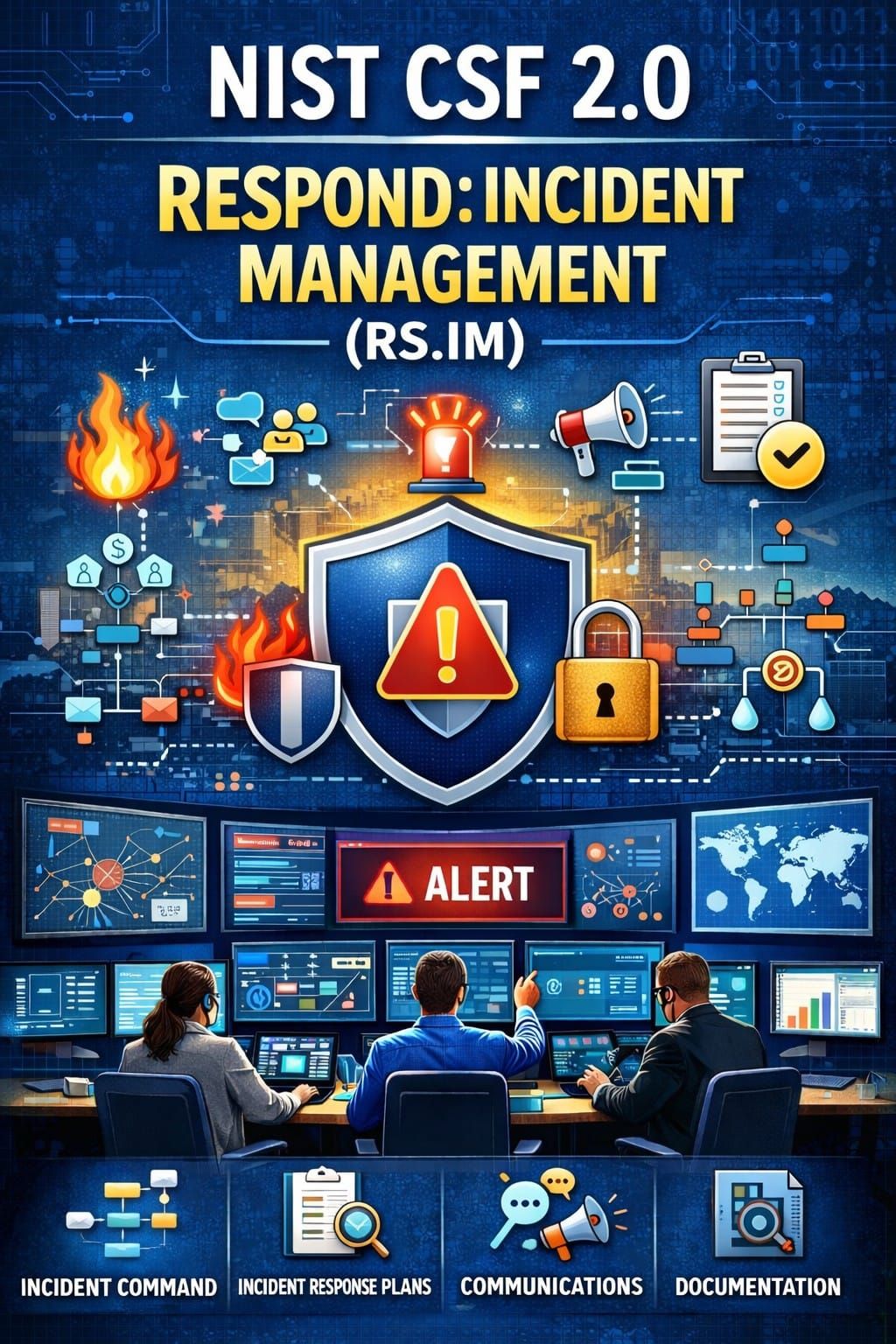
Detection gets the attention. Response defines the outcome.
In my career, I’ve seen organizations with excellent detection capabilities still suffer outsized damage because they could not manage incidents in a disciplined, repeatable way. Tools didn’t fail them—process and leadership did.
That is why NIST CSF 2.0 Respond – Incident Management (RS.IM) is one of the most business-critical categories in the entire framework.
For aspiring CISOs and early-career security professionals, RS.IM is where cybersecurity becomes executive-level crisis management.
What Is Incident Management (RS.IM) in NIST CSF 2.0?
RS.IM focuses on an organization’s ability to effectively respond to cybersecurity incidents through coordinated, structured, and governed actions.
In plain terms, RS.IM answers:
“When something bad happens, do we respond deliberately—or chaotically?”
Under CSF 2.0, Incident Management includes:
- Incident declaration and classification
- Roles, responsibilities, and authority
- Coordination across technical and business teams
- Communication and escalation
- Tracking, documentation, and closure
This is not just a SOC concern. Incident management is an enterprise capability.
Why Incident Management Matters to Executives
From the board’s perspective, security incidents are not technical events—they are business disruptions.
Strong RS.IM enables:
- Faster containment and recovery
- Reduced legal and regulatory exposure
- Clear executive decision-making
- Confidence under pressure
Weak incident management leads to:
- Conflicting messages
- Delayed actions
- Lost evidence
- Reputational damage
Many breaches become crises not because of attackers—but because of uncoordinated response.
Core Objectives of RS.IM
A mature Incident Management capability ensures:
- Incidents are declared consistently
- Authority and accountability are clear
- Technical and business actions stay aligned
- Decisions are documented and defensible
- Recovery begins as early as possible
If Detect tells you what is happening, Respond determines how bad it becomes.
How to Implement RS.IM Effectively
1. Define What Constitutes an “Incident”
One of the most common failures I see is ambiguity.
Organizations must clearly define:
- What qualifies as a security incident
- Severity categories (e.g., low to crisis)
- Regulatory or legal triggers
- Executive notification thresholds
Clarity prevents hesitation during critical moments.
2. Establish Formal Incident Roles and Authority
During incidents, consensus kills speed.
RS.IM requires predefined roles, including:
- Incident Commander
- Technical Leads
- Legal / Privacy
- Communications
- Business Owners
- Executive Sponsor
Aspiring CISOs should note: authority must be explicit, especially for isolation, shutdowns, and disclosures.
3. Develop and Maintain Incident Response Plans
Incident plans should be:
- Scenario-based (ransomware, cloud compromise, insider threat)
- Practiced regularly
- Updated based on lessons learned
- Integrated with BC/DR and crisis management
Shelfware plans fail when needed most.
4. Coordinate Communication Internally and Externally
Incident management is as much about communication as containment.
RS.IM must address:
- Internal updates
- Executive briefings
- Legal and regulatory notifications
- Customer or partner messaging
Silence, speculation, or inconsistency magnify damage.
5. Track and Document Every Incident
Documentation is not bureaucracy—it is protection.
Effective RS.IM ensures:
- Timelines are captured
- Decisions are justified
- Evidence is preserved
- Lessons are retained
This supports audits, insurance claims, regulatory reviews, and post-incident improvement.
Metrics to Measure Incident Management Effectiveness
Operational Metrics
- Mean Time to Contain (MTTC)
- Mean Time to Recover (MTTR)
- Incidents escalated correctly
- Incident backlog volume
Effectiveness Metrics
- Incidents exceeding SLA thresholds
- Re-opened incidents
- Regulatory findings tied to response failures
- Repeat incidents with similar root causes
Maturity Metrics
- % of incidents with documented timelines
- % of incidents with executive involvement when required
- Frequency of incident response exercises
- Time to executive situational awareness
For CISOs, metrics should translate into risk reduction and business resilience, not just speed.
Common RS.IM Pitfalls
These are patterns I consistently see:
- No clear incident commander
- Over-involvement too early (or too late)
- Legal and PR engaged only after escalation
- Poor handoffs between Detect and Respond
- No post-incident learning
Incident management failures compound technical impact.
Final Guidance for Aspiring CISOs
Incident Management is where leadership matters most.
When pressure is high and information is incomplete:
- People look for structure
- Executives look for clarity
- The organization looks for confidence
If Detect earns you credibility, Respond determines whether you keep it.
Master RS.IM, and you move from security operator to trusted executive leader.
Comments ()