
NIST CSF 2.0 Respond – Mitigation (RS.MI) Explained
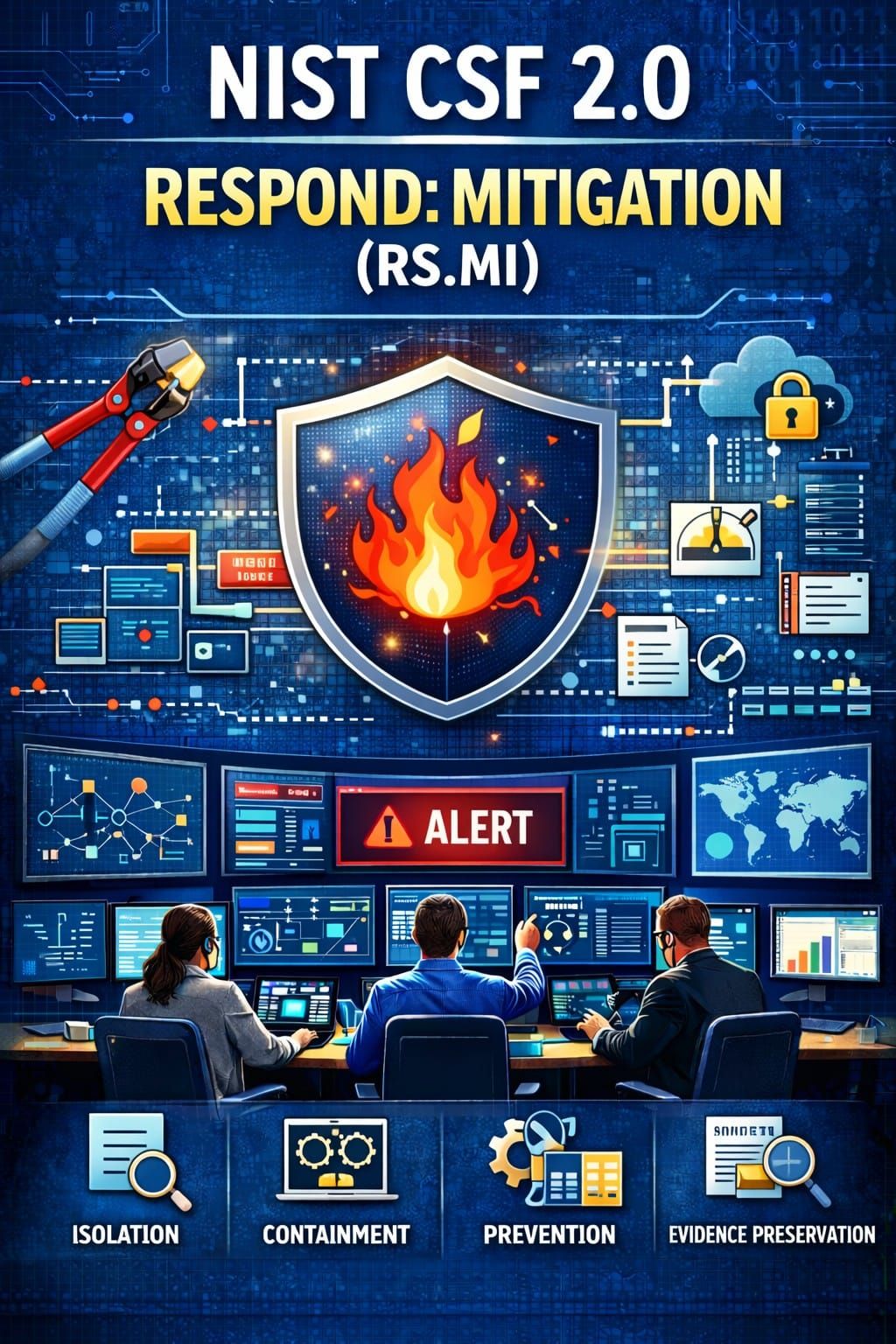
If Incident Management is about orchestration, Incident Analysis is about understanding, and Response Communications is about control of the narrative, then Mitigation is about decisive action.
Mitigation is where security teams move from talking about risk to actively reducing it—while the incident is still unfolding.
In my experience, this is the moment executives remember most:
“Did we stop the damage?”
NIST CSF 2.0 Respond – Mitigation (RS.MI) exists to ensure that the answer is yes.
What Is RS.MI in NIST CSF 2.0?
RS.MI focuses on containing, eliminating, and limiting the impact of a cybersecurity incident through deliberate technical and procedural actions.
It addresses questions such as:
- How do we stop the threat from spreading?
- What actions reduce immediate business impact?
- How do we prevent reinfection or recurrence during response?
- How do we balance speed with safety?
Mitigation is not recovery—and it is not root cause analysis.
It is controlled damage reduction under pressure.
Why Mitigation Matters to CISOs
From a leadership perspective, Mitigation is where:
- Business interruption is minimized
- Data loss is limited
- Regulatory exposure is reduced
- Confidence in security leadership is earned
Poor mitigation decisions can:
- Expand blast radius
- Destroy forensic evidence
- Cause unnecessary outages
- Create secondary incidents
Strong RS.MI capabilities separate operational responders from strategic security leaders.
Core Objectives of RS.MI
A mature Mitigation capability ensures:
- Threats are rapidly contained
- Impact is reduced as quickly as possible
- Actions are intentional—not reactive
- Forensics and recovery are preserved
- Business priorities are considered in technical decisions
Mitigation is about precision, not panic.
How to Implement RS.MI Effectively
1. Predefine Approved Mitigation Actions
During an active incident is the worst time to debate fundamentals.
Organizations should predefine:
- Network isolation procedures
- Endpoint containment steps
- Account disabling thresholds
- Temporary compensating controls
- Cloud and SaaS response actions
Aspiring CISOs should ensure mitigation playbooks are approved in advance—especially for actions that impact availability.
2. Balance Containment with Business Impact
Not every incident warrants pulling the network cable.
Effective RS.MI requires:
- Risk-based decision-making
- Understanding business-critical assets
- Executive involvement for high-impact actions
- Temporary controls when permanent fixes are unsafe
Mitigation should limit damage without creating new risk.
3. Coordinate Mitigation Across Teams
Mitigation rarely belongs to security alone.
Effective execution requires coordination with:
- IT operations
- Cloud and infrastructure teams
- Application owners
- Identity and access management
- Third-party providers
Uncoordinated mitigation actions often cause:
- Outages
- Broken dependencies
- Data integrity issues
This is why RS.MI depends heavily on strong RS.IM foundations.
4. Preserve Evidence While Taking Action
One of the most common mistakes I see is over-mitigating too early.
Mitigation should:
- Capture volatile data before isolation
- Preserve logs and snapshots
- Maintain chain-of-custody where required
- Avoid wiping systems prematurely
You can’t analyze what you’ve destroyed.
5. Track and Reassess Mitigation Effectiveness
Mitigation is iterative.
Strong teams:
- Reassess threat activity post-action
- Validate containment
- Adjust controls as attackers adapt
- Document effectiveness in real time
Mitigation is rarely a single step—it is a controlled sequence.
Metrics to Measure RS.MI Effectiveness
Speed and Containment Metrics
- Time to containment
- Time to mitigation action approval
- Percentage of incidents contained within SLA
- Lateral movement duration
Impact Reduction Metrics
- Systems affected before vs after mitigation
- Data exposure reduction
- Downtime avoided through targeted mitigation
- Repeat containment actions required
Maturity Metrics
- % of incidents using predefined mitigation playbooks
- Frequency of mitigation-related outages
- Evidence preservation success rate
- Lessons learned implemented post-incident
Good mitigation metrics measure impact reduced, not just actions taken.
Common RS.MI Pitfalls
Even mature organizations struggle with:
- Shutting down too much, too fast
- Acting without executive alignment
- Breaking production systems
- Losing forensic visibility
- Treating mitigation as recovery
Mitigation mistakes often don’t show up immediately—but they always surface later.
Final Guidance for Aspiring CISOs
Mitigation is where technical skill meets executive judgment.
Strong CISOs:
- Know when to act quickly
- Know when to pause
- Know when to escalate
- Know how to explain tradeoffs clearly
If Response Communications controls perception, Mitigation controls reality.
Get this right, and you don’t just stop incidents—you protect the business when it matters most.
Comments ()