
NIST CSF 2.0 Roles, Responsibilities, and Authorities (GV.RR): Eliminating Ambiguity in Cybersecurity Leadership
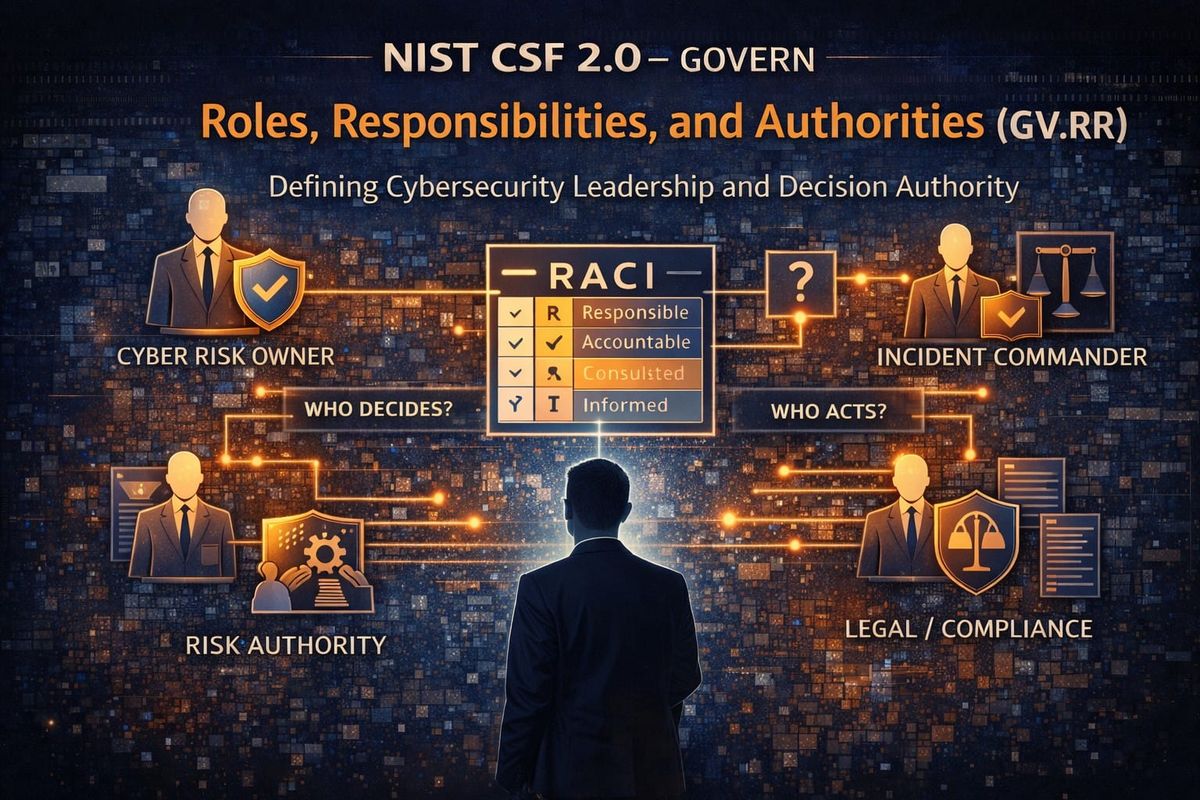
After more than twenty years leading cybersecurity programs in global enterprises, I’ve seen sophisticated security architectures fail for one simple reason: no one was truly accountable.
Technology does not fail in isolation—organizations do. GV.RR exists to eliminate the ambiguity that undermines even the most mature security programs by clearly defining who is responsible, who is accountable, and who has authority to make decisions about cybersecurity risk.
In NIST CSF 2.0, GV.RR formalizes something CISOs have long known: governance without clear ownership is performative.
What GV.RR Is
GV.RR – Roles, Responsibilities, and Authorities focuses on ensuring that cybersecurity responsibilities are clearly defined, assigned, communicated, and enforced across the organization.
GV.RR answers leadership-level questions such as:
- Who owns cyber risk at the enterprise level?
- Who has authority to accept or transfer risk?
- How do responsibilities differ between IT, security, legal, compliance, and the business?
- Who leads during incidents—and who supports?
- How are conflicts resolved when priorities compete?
Without clarity here, organizations rely on assumptions—and assumptions collapse under pressure.
Why GV.RR Matters at the Executive Level
From an executive perspective, GV.RR enables speed, confidence, and accountability.
When roles and authorities are clear:
- Decisions are made faster during incidents
- Risk ownership is transparent
- Security is embedded into business execution
- CISOs are empowered—not scapegoated
- Boards know who is accountable
When GV.RR is weak:
- Decisions stall during crises
- Risk is silently accepted without authority
- Security becomes everyone’s job—and no one’s responsibility
- Post-incident reviews devolve into blame-shifting
Clear governance protects people as much as it protects the organization.
How to Implement GV.RR in Practice
1. Define Enterprise Cybersecurity Accountability
At the highest level, accountability must be explicit.
Best practices include:
- Formal designation of an enterprise cyber risk owner
- Clear accountability models for security outcomes
- Documentation approved by executive leadership
Accountability should not be assumed based on job titles alone.
2. Clarify Role Responsibilities Across Functions
Cybersecurity is inherently cross-functional.
Effective GV.RR implementation clarifies roles across:
- Executive leadership
- Information security
- IT and infrastructure
- Legal, privacy, and compliance
- Risk management
- Business unit leadership
- Third parties
Responsibility matrices (e.g., RACI) are useful—if kept current and enforced.
3. Establish Decision-Making Authority
Responsibility without authority is organizational theater.
GV.RR requires clarity on:
- Who can accept cyber risk and at what threshold
- Who approves exceptions and compensating controls
- Who initiates incident response and business continuity actions
- Who communicates externally during incidents
Authority must be documented, delegated, and defended.
4. Align Roles to Risk Management Strategy
GV.RR should directly support GV.RM.
This means:
- Mapping roles to risk assessment processes
- Assigning clear ownership for risk treatment actions
- Ensuring escalation paths are explicit
Governance coherence matters more than governance volume.
5. Exercise and Validate Roles Regularly
Roles that are never tested will fail under stress.
Leading organizations:
- Conduct tabletop exercises
- Validate incident command structures
- Review role clarity during post-incident lessons learned
- Update responsibilities as the business evolves
Governance must be lived, not laminated.
Metrics That Matter for GV.RR
GV.RR metrics focus on clarity, timeliness, and effectiveness, not headcount.
Governance Effectiveness Metrics
- Percentage of key cyber roles formally documented
- Leadership acknowledgement of risk ownership
- Frequency of role reviews tied to organizational change
Decision Velocity Metrics
- Time to decision during incidents
- Number of escalations caused by unclear authority
- Reduction in stalled remediation efforts
Accountability Metrics
- Percentage of risks with a named business owner
- Closure rates for assigned risk treatment actions
- Exception approvals by role and level
Culture Indicators
- Stakeholder feedback on role clarity
- Decrease in post-incident confusion
- Increased cross-functional participation in security initiatives
These metrics reveal whether governance is operational or aspirational.
Common GV.RR Anti-Patterns
Even mature organizations struggle with:
- Over-centralizing decision authority
- Assuming the CISO owns all cyber risk
- Allowing informal authority to override documented roles
- Failing to align roles after reorganizations or M&A
- Neglecting third-party accountability
GV.RR exists to counter these failure modes.
How GV.RR Connects to the Govern Series
- GV.OC defines what matters
- GV.RM defines how risk decisions are made
- GV.RR defines who decides and who acts
Together, they form the minimum viable governance structure for effective cybersecurity leadership.
Final Thought
In NIST CSF 2.0, GV.RR is about removing ambiguity before it becomes risk. It enables decisive leadership, protects individuals from unfair accountability, and ensures cybersecurity governance holds under pressure.
For CISOs, clarifying roles and authorities is not bureaucracy—it is leadership.
If cybersecurity is to scale with the business, responsibility must be explicit, authority must be trusted, and accountability must be fair.
Comments ()