
One Engineer's Laptop Reached $6.3 Billion: How to Shrink What a Single Endpoint Can Touch
The views expressed are my own and do not represent those of my employer.
Imagine a senior DevOps engineer on a Thursday afternoon. She is good at her job. Her laptop holds a live cloud session and a token for the deploy pipeline. She opens a file from someone she believes is a collaborator. Nothing happens. No warning, no slowdown, no pop up.
Twenty minutes later, someone far away is using her access to ask a service for something it was built to do. The service does not question the request. It was designed to trust its caller.
That engineer is fictional. The shape of the story is not.
Binance, the world's largest crypto exchange, is now at the center of what looks like the largest crypto theft on record. According to Binance's preliminary findings, a compromised DevOps engineer's laptop gave the attacker access to a service container, which triggered the unauthorized withdrawals. On October 31, 2026, the FBI said North Korea was responsible for the theft of more than $6 billion, on or about October 29, and called the activity TraderTraitor.
Four days earlier, a second story broke. On October 28, the Treasury Department sanctioned 10 individuals and one entity tied to an alleged scheme to defraud American businesses for the benefit of the North Korean military. That scheme works through hiring, not malware.
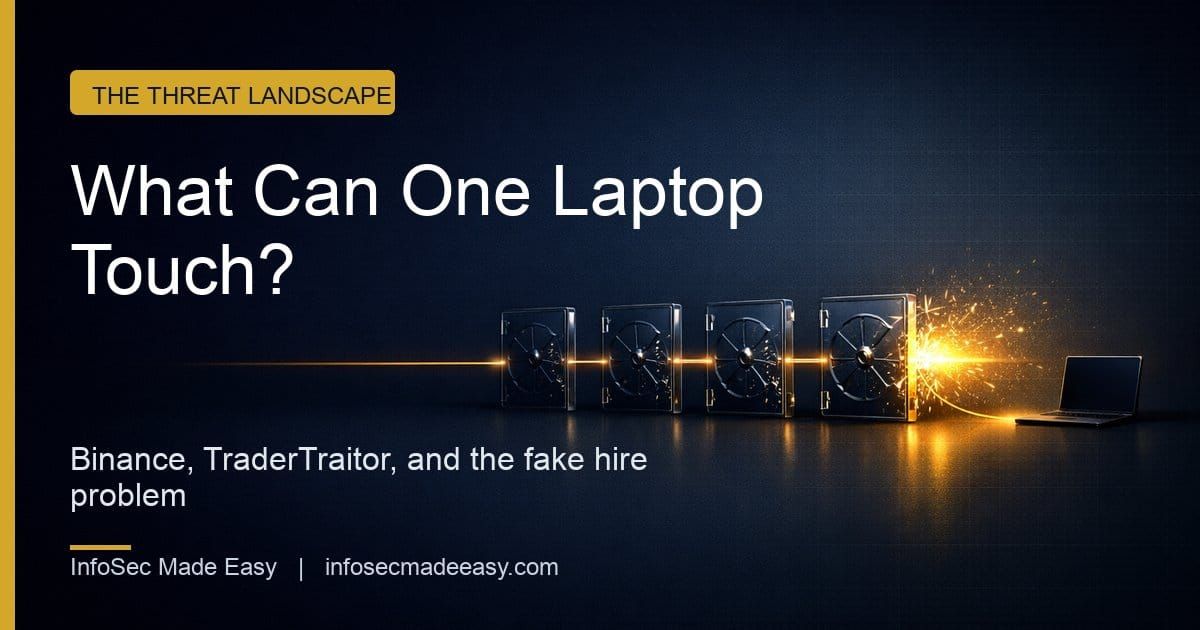
Put those two stories side by side. The same state is going after your engineers' endpoints and your recruiting pipeline. Both attacks aim at one thing: a person with legitimate access. If you are a CISO or growing into the role, you need a clear answer to one question. If one engineer's machine is owned tomorrow, what is the most it can touch?
Most of us cannot answer that with confidence. That gap is what this post is about.
What Binance Has Said, and What Nobody Knows Yet
Start with discipline about the facts. This incident is days old, and the public record is thin.
Binance first said its investigation pointed to a compromised laptop. It later said a subsequent investigation uncovered additional "points of breach." The FBI's announcement does not explain how the engineer's laptop was compromised or give a full account of the attack. So the entry method is unconfirmed. Anyone telling you exactly how it happened this week is guessing.
The scale is not in doubt. TRM Labs said an attacker moved approximately $6.36 billion out of Binance wallets on ten blockchains, most of it in about 20 minutes. Binance worked with blockchain partners to freeze roughly $3 billion in affected assets.
I am not writing this to second guess Binance. I have no inside view, and I will not pretend to have one. I am writing because the architecture described in public reporting, an engineer endpoint with a path to a service that can move value, exists in almost every large company. Yours has a version of it.
This Is the Second Time, and the Playbook Is Consistent
Binance is not the first target. In February 2025, the FBI said North Korea was responsible for the theft of approximately $1.5 billion from the exchange Bybit, and referred to that activity as TraderTraitor.
That earlier case is worth rereading. According to Fortune's reporting, after hackers duped a system admin at Bybit's wallet provider, Safe, they used the access to download malware to the developer's machine, which gave North Korea control of the admin's computer. The employee unknowingly authorized the command, and North Korea was suddenly flush with $1.5 billion in crypto.
TRM said several features of the Binance attack match earlier North Korea linked heists, including Bybit. I will not claim the technical details are identical. They are not confirmed. The pattern is what matters. Find a technical person with trusted access. Compromise the machine. Let the legitimate workflow do the rest.
The attacker does not need to break your best control. The attacker needs one person whose laptop sits too close to it.
Ask the Question Before an Attacker Does: What Is the Most One Laptop Can Touch?
I call this the blast radius question. It is simple to ask and painful to answer honestly.
Take one engineer with production access. List everything their laptop can reach in the first 30 minutes after compromise. Count the browser sessions already signed in. Count the cloud CLI profiles, the SSH keys, the password manager, the pipeline tokens and the chat tool that can approve requests. Then follow each one. Which of those can change production? Which can move money, release a payment, sign code or alter a master record?
Most teams discover that the answer is longer than anyone thought. Not because anyone was careless. Access piled up over years because it made work faster.
My recommendation is to run this as a working exercise with the engineering lead in the room, not as a security audit done to them. Engineers know where the shortcuts live. If you ask the question with respect, they will show you.
If you want the broader principle behind this, I covered it in the NCSC series. Limiting the impact of compromise is a design goal, not a hope. You assume the endpoint falls and you build so that the fall is survivable.
Give Admins a Second Computer: Privileged Access Workstations
A privileged access workstation is a dedicated, hardened machine used only for high risk administrative work. It does not read email. It does not browse the open web. It does not run chat apps or random plugins. It exists to touch production and nothing else.
The logic is plain. The daily laptop is where engineers open attachments, test packages from public repositories and join calls with strangers. That is where attackers will land. If the same machine also holds the keys to production, one mistake becomes a catastrophe.
Enforce it at the door, not by policy. A PAW only works if production refuses everything else. Use conditional access so admin portals, cloud consoles and pipeline controls accept sessions only from compliant, managed admin devices. A written rule that says "use the PAW" will lose to a deadline every time.
Keep the PAW boring. Fewer apps, tight allow lists, no local admin rights, and no personal use. If engineers start installing tools on it to get work done, the design has failed and you need to fix the friction, not scold the people.
A virtual desktop or a hardened jump host can work where a physical second device is impractical. The test is the same either way. If someone compromises the daily laptop, they should find no credentials that open the administrative path.
Split the Signing Path From the Production Path
This is the control that matters most when the target is money, code signing keys or any system where one request can cause irreversible harm.
The rule: the system that proposes an action and the system that approves it must not share a trust path. If a compromised laptop can both draft and authorize, you have one control, not two.
The Bybit case shows why. Approvers acted on what they saw. If an attacker controls what the approver sees, a two person rule collapses into a rubber stamp. So build approval around independent verification. The approver checks the real transaction details on a separate device, using keys held in hardware, with limits enforced by a policy engine that does not take instructions from the requester.
Translate this to your own business. You may not move crypto. You still have a version of a withdrawal. It might be a payment release, a bank detail change, a software signing key, a production deploy or a bulk change to master data in your ERP. Name your three worst irreversible actions. For each one, ask who can propose it, who can approve it, and whether a single endpoint can influence both.
Two approvals that run through the same compromised machine are one approval with extra steps.
Standing Access Is a Liability: Just in Time for DevOps
Engineers carry permanent privileges for convenience. Permanent privileges are what an attacker inherits.
Just in time access flips the default. The engineer has no standing rights to production. When a task requires them, they request elevation for a specific purpose and a fixed window. The highest tier needs a second person's approval. The session is logged. The rights expire on their own.
Apply the same thinking to workloads. The service container in the Binance account could submit withdrawals. Ask the same of yours. Which service accounts can move value or change critical data? How are they authenticated? Can a human credential reach them? Short lived credentials, scoped to one function, with no path from a developer laptop to a workload that holds transaction authority, cut off the route the public reporting describes.
I wrote earlier about containing non human actors with least privilege and containment for AI agents. The logic applies to service containers, pipelines and engineers alike. You cannot predict what will be compromised. You can limit what it can do.
Developer laptops should reach development and staging. Production changes should flow through a reviewed pipeline, not through a terminal on a personal workstation. This will slow some engineers down at first. Explain why, and measure the friction so you can fix it.
Put a Speed Limit on the Money
Twenty minutes is not long enough for most security teams to detect, triage, escalate and decide. If your control depends on someone noticing in time, attackers can beat it.
Build preventive caps. Velocity limits that stop large cumulative transfers in a short window. Thresholds that route big actions to a slower approval lane with a human delay. Circuit breakers that pause a workflow when behavior departs sharply from normal. Most companies already do this for fraud in payments. Fewer apply it to automated service paths and engineering driven changes.
The goal is not to stop every attack. The goal is to make the maximum loss from one compromised path smaller than the amount that would hurt the company. That is a number you can give the board.
The Other Door Is Hiring
Now the second half of the problem. An attacker who cannot phish an engineer can try to become one.
The October 28 Treasury action shows the revenue side of the scheme. The North Korean government uses fraudulent documents, stolen identities and fake personas to conceal its IT workers and secure employment with real companies. Treasury said six North Korean IT workers affiliated with one sanctioned center used artificial intelligence tools and sophisticated money laundering methods to generate more than $750,000. An earlier network the Treasury designated allegedly generated nearly $800 million for North Korea in 2024.
The risk goes beyond a salary paid to the wrong person. Treasury Secretary Scott Bessent said these operatives "weaponize sensitive data and extort businesses for substantial payments." The FBI has warned that North Korean IT workers have used unlawful access to company networks to exfiltrate proprietary and sensitive data.
Enforcement is also catching up with the infrastructure. On October 13, 2026, the FBI and DOJ announced charges against 14 individuals, two arrests, the seizure of nearly 190 devices and operations at more than 40 suspected laptop farms across Texas. The DOJ said the actions affected more than 70 U.S. companies.
Connect the dots for your own program. A fake hire who lands a DevOps role is the compromised engineer problem, delivered through HR. The laptop is real, the credentials are real and the intent is hostile from day one.
A fake engineer does not need to defeat your endpoint controls. You hand over the endpoint and the access on day one.
Verify Identity at Every Stage, Not Once
Most hiring processes check identity as a single event. North Korean operatives are built to pass single events.
The FBI has observed North Korean IT workers using artificial intelligence and face swapping technology during video job interviews. An FBI public service announcement described how workers pay Americans to appear on camera during interviews, verify identities, ship packages and keep devices online. One secondary summary of the FBI's October 2026 guidance describes the answer as "identity in depth": combine identity assurance with continuing technical and behavioral monitoring instead of trusting one interview or one document.
My recommendation is to treat identity as a chain with checks at each link. Verify during interviews, again at onboarding, and again at moments that matter after hire. The FBI's 2025 guidance says to implement identity verification processes during interviewing, onboarding and throughout the employment of any remote worker.
Watch the equipment trail. CrowdStrike reported operatives filing fraudulent police reports claiming a laptop was stolen, to trigger replacement shipments to farm addresses. A replacement request should trigger an identity check through a channel the requester does not control, such as a known phone number in your HR system.
Look for remote control hardware and software. Laptop farms depend on remote access tooling. Investigators in the Texas raids seized laptops and KVM switches used to make overseas workers appear to operate from U.S. locations. Your endpoint team can flag unapproved remote access tools and impossible location patterns.
Start new remote hires with least privilege. Trust should grow with verified tenure. A new engineer does not need production access in week one. This is the same blast radius logic applied to people.
I covered how identity programs connect to risk and money in a post for audit committees: turning IAM metrics into risk and ROI numbers. Hiring verification belongs in that same conversation.
Contractors Inherit Your Risk, and Your Liability
Contract IT staff are a favorite route. The FBI recommends verifying that third party staffing firms conduct hiring practices that hold up, and auditing those practices routinely. You are removed from the hiring decision, but you hand the contractor the same laptop and the same access.
Write identity proofing into staffing contracts. Ask for the verification records and an audit right. Require notice if a worker changes, because a different person logging in under the same name is the whole scheme.
There is also a legal dimension. A joint alert from the FBI and allied governments, as summarized by CybersecurityNews, says that contracting with and paying North Korean nationals can violate UN Security Council Resolution 2397 and domestic sanctions laws. I am not a lawyer. Ask your general counsel what your exposure looks like before you need to ask.
Getting Organizational Support: Sell the Limit, Not the Tool
None of this works if engineers see it as punishment and executives see it as a cost line. Frame it in business risk language and tailor the ask to each audience. I covered the fundamentals of building executive support in Winning the Room. Here is how I would apply them to this topic.
The board. Do not walk in with TraderTraitor tactics or tool names. Ask the one question that matters: what is the most one laptop can touch? Then answer it in business terms. Which operations stop, which payments or releases could be forced, and what is the worst case loss from a single compromised account? Directors understand concentration risk. A single point of failure is a concept they already govern in finance.
The CEO and CFO. Present a loss cap. Show today's maximum exposure from one compromised path, the target number after controls, and the cost to get there. Tie it to the spend decisions they already make, such as payment controls and segregation of duties. Finance leaders have been separating who proposes from who approves for decades. You are asking them to extend a principle they already trust.
The general counsel and HR. Hiring fraud is a legal, compliance and reputational problem as much as a security one. Bring counsel in on sanctions exposure. Bring HR in on identity verification steps that treat every candidate the same way. Consistent checks at fixed stages protect candidates from bias and protect the company from the scheme.
Engineering leadership. Sell the design as protecting engineers. A PAW and just in time access mean a stolen laptop does not become a career ending event. Co-design the workflows so approvals take minutes, not days, and report the approval times publicly. If the control slows delivery without explanation, it will be bypassed.
Internal audit and risk. Offer testable statements: no standing production access for standard engineers, no admin session from an unmanaged device, no single endpoint that can propose and approve a critical action. Audit can verify those. That earns you an ally and an independent view of progress.
Key Points
- Binance's preliminary account points to one compromised engineer laptop reaching a service container that could submit withdrawals. The full method is not public.
- The FBI attributed the theft to North Korea's TraderTraitor on October 31, 2026, and the Bybit theft in 2025 carries the same label.
- Treasury sanctioned 10 individuals and one entity on October 28, 2026, over North Korean IT worker schemes. The same state attacks endpoints and hiring.
- Map the blast radius: list what one engineer laptop can reach in the first 30 minutes.
- Use privileged access workstations and enforce them with conditional access, not policy.
- Separate the path that proposes an action from the path that approves it.
- Remove standing production access. Use just in time elevation for people and short lived credentials for workloads.
- Verify identity at interview, onboarding and throughout employment, and audit staffing firms.
- Give the board one question: what is the most one laptop can touch?
Pro Tips
Run the stolen laptop drill. Pick a real engineer, with their blessing, and assume their device is fully compromised right now. Give a small group 60 minutes to list every system the attacker could reach and every irreversible action they could trigger. The list is your roadmap. It beats any vendor assessment because it uses your actual access paths.
Audit the service accounts that can move value. Everyone reviews human admins. Few review the non human identities with transaction authority. Find the ones that can pay, release, sign or delete. Check who can reach them and how their credentials are stored.
Make the replacement laptop request a security event. Reship requests, address changes and payment platform changes during onboarding are signals the FBI has called out. Route them through a verification step that HR and IT both own.
Treat the first 90 days as probation for access. New remote engineers get development and staging first. Production rights follow verified tenure and a manager sign off. It costs little and removes the most attractive window for an operative.
Read the approval screen as an attacker would. For every critical approval, ask what the approver actually sees and who controls that display. If the answer is the same system that made the request, you have found your next project.
Pitfalls to Avoid
Do not treat this as a crypto problem. Your industry may not hold digital assets, but you hold something one request can damage: payments, code signing, production changes, master data. The structure is the same.
Do not announce the cause of the Binance breach as fact. Public details are preliminary. Brief your leadership on what is confirmed and mark the rest as unknown. Credibility matters more than speed.
Do not roll out a PAW without fixing the workflow. If engineers cannot get their jobs done, they will route around the control and you will have a policy with no protection.
Do not rely on one identity check. A single video call or a single document is what these operations are designed to pass. Layer the checks and keep them going after the offer letter.
Do not build discriminatory screening. Checks must apply to every candidate at the same stages. Name based or nationality based filters create legal risk and miss proxies using stolen identities.
Do not forget the contractor. If your staffing firm can place someone on your network with no proof of identity, your hiring controls stop at your front door.
Do not report outputs instead of limits. Counting deployed workstations tells the board nothing. Report the reduction in what one compromised endpoint can touch.
Final Thought
Attackers keep succeeding against well funded companies because they target the seam where trust meets convenience: the engineer, the laptop and the service that never says no. You will not stop every phishing attempt, and you will not catch every fake candidate. You can decide, in advance and on paper, how much any one person or machine is allowed to break, and that decision belongs to you.
If this post made you rethink what one laptop can reach in your environment, I want to hear what you found. Leave a comment with the hardest part of the exercise, subscribe so the next post lands in your inbox, or share this with the engineering leader who needs to hear it. I read every one.


Comments ()